We use cookies to make your experience better. To comply with the new e-Privacy directive, we need to ask for your consent to set the cookies. Learn more

A Concise Guide to the Brown Bess

Whether you’re a firearm enthusiast or not, it's fair to say most people have heard of the name ‘Brown Bess’. The gun had a large hand in not only building an empire that once covered a quarter of the Earth’s surface and ruled the waves, but also laying the foundations of the world as we know it today.
There are articles, books and indeed videos galore on the Brown Bess, however the objective of this short blog is to try and give the reader a very brief and simple overview of them and some indication on how to identify one.
To better appreciate these differences it is useful to understand a little of the history behind the Brown Bess.
In the early 18th century, the British Army introduced its first largely standardised firearm, the Long Land Pattern Flintlock Smoothbore Musket, a name almost as long as the weapon itself! Before this, Colonels who raised and funded their individual regiments were permitted to arm and equip them as they saw fit, naturally leading to various logistical problems.

The adoption, in 1722, of the Long Land Pattern went some way to solving these issues with a standard calibre and length etc, although it would be approaching another 150 years before individual parts were interchangeable. The inclusion of the word land in the name refers to the intended use of the musket - i.e. by land forces. Muskets for use on board naval ships or by marines usually are referred to as sea service patterns.
There are numerous tales and theories as to how the name ‘Brown Bess’ came about but this article is not the place for that, perhaps we may do one in the future.
In the simplest of ways, the Brown Bess can be separated into three patterns, though aficionados will cite numerous variations, these three models are all distinguishable by the length of the barrel;
The Long Land Pattern - 46 Inches
This is the earliest form of the Brown Bess musket and had a long barrel length of 46 inches. The theory here is that the longer the barrel, the longer you can dictate the flight of the ball, thus making it more accurate. The reality however is somewhat different.
These early Brown Bess muskets usually have a date and the name of the individual gunsmith on the tail of the lock plate. They also feature 4 brass ramrod pipes securing the ramrod under the barrel.

A Militia Long Land Pattern Brown Bess Circa 1740, 46" Barrel
A good .75 cal (10 bore) Militia Long Land Pattern Brown Bess flintlock musket, c 1740, 62"" overall, barrel 46"" with Tower private proofs and engraved ""6=Freeman=London"", the plain unbridled lock engraved ""Freeman"" and ""6"" on the tail, pale walnut stock with brass mounts including four ramrod pipes and escutcheon engraved with ""M"" over ""6"", sling swivels, original steel ramrod, and triangular socket bayonet also numbered ""6"". Stock makers mark also visable below the trigger guard. In Good working Order. Barrel Length - 118cm. Overall Length - 158cm. Bayonet Blade Length - 43.5cm. ** Provenance - Ex Shirburn Castle, Oxfordshire, one of a set of 50.
This particular example be viewed on our website here.
The Short Land Pattern - 42 Inches
The second version, as it were, started to come onto the scene around 1769 and saw a reduction in the barrel length from 46 to 42 inches in an attempt to make the firearm less cumbersome, and rather primitively became known as the ‘short’ land pattern. Again this pattern will usually have 4 brass ramrod pipes and the locks are named and dated until around 1777.

A Scarce .750 Calibre Pattern 1769 Flintlock Brown Bess Short Land Pattern Musket, 42" Barrel
A scarce .750 calibre pattern 1769 flintlock Short Land Pattern Musket with a 42 inch sighted barrel, border engraved bevelled lock stamped with a crown over GR and TOWER across the tail, full stocked with regulation brass mounts to include flat scroll sideplate and shield shaped escutcheon to the back of the wrist, iron ramrod. Barrel Length - 107cm. Overall Length - 146cm.
This particular example can be viewed on our website here.
The India Pattern - 39 Inches
Without a doubt this is the most famous of the Brown Bess family and also the most numerous with estimates of over 2 million being made between 1793 - 1815!
When war with France was declared in 1793, the Board of Ordnance was left with a major shortfall in the number of firelocks available to them. This resulted in them asking the East India Company (EIC), who had a large standing army of their own, if they had any muskets available.
The EIC used a pattern of musket of simpler manufacture, and although not quite up to the Board of Ordnance's stance on quality and craftsmanship, these muskets were very robust as well as cheaper and quicker to produce, a win - win in a war situation. The India Pattern has a 39 inch barrel and 3 brass ramrod pipes. The locks are no longer dated and are stamped with TOWER.

An Original Indian Pattern Flintlock Brown Bess Musket, 39" Barrel
A very good antique 10-bore flintlock India Pattern Brown Bess musket with 39 inch sighted barrel, London proof marks, with border engraved lock stamped with a crown over GR and TOWER across the tail, brass furniture with brass trigger guard, three ramrod pipes, sideplate, buttplate with HR and initials (JJL) engraved on it, two sling swivels, original ramrod. fully stocked in walnut with numerous military stamps and stamped in the ramrod channel with the stock makers name of T. ASHTON . In very good working order. In general it is very difficult to find a Brown Bess in this sort of order. Barrel Length - 99cm. Overall Length - 138cm.
This particular example can be viewed on our website here.
As mentioned previously, the above is by no means a definitive identifying guide and there are several models not mentioned, such as the sea service, however it will give the reader a basic understanding of identifying some key differences between patterns.
In the hands of Britain's redcoats, the Brown Bess would march across the globe and see action in many famous battles from Trafalgar to Waterloo and Bunker Hill to Assaye.
The legacy of Brown Bess musket continues to this day with appearances in films and TV shows such as Waterloo (1970), The Patriot (2000), Master And Commander (2003) and of course Sharpe (1993 - 2008).
Can I Own A Brown Bess?
Yes, you can! Owning a piece of history and indeed a star of the silver screen has never been easier.
Here at Henry Krank, we have a fantastic variety of Brown Bess Muskets for sale. Whether you're a collector looking for an original Brown Bess Musket, a reenactor who wants a reproduction to shoot or just an enthusiast who wishes to own a display piece without the need for a licence, we have a Brown Bess for you.
Original Antique Brown Bess Muskets

We're exceptionally proud to have a fantastic collection of original Antique Brown Bess Muskets for sale. These are true pieces of history, with scarce models commonplace in our selection.
SHOP ANTIQUE BROWN BESS MUSKETSReproduction Brown Bess Muskets (Shotgun Licence)

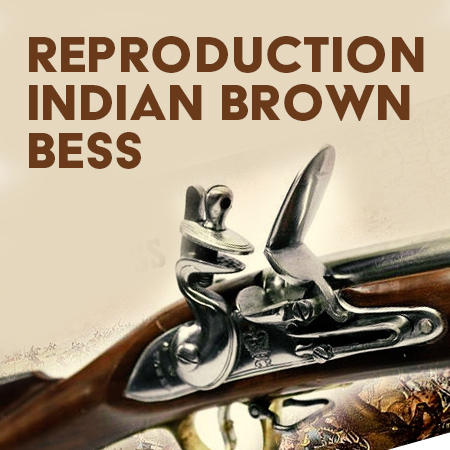
Alongside our Antique Brown Bess Muskets, we have a range of reproduction firearms that are available to purchase on a shotgun licence.
Also, make sure to read our blog - Shooting With A Reproduction Brown Bess.
SHOP REPRODUCTION BROWN BESS MUSKETSInert Brown Bess Muskets For Display

Alternatively, you can own a fantastic display piece without the need of a licence!
Our Inert Replica Muskets are perfect for display and wall hanging. They are exceptionally accurate in terms of scale, appearance and detail.
Inert Replica Muskets cannot be loaded, they do not fire live ammunition or blank rounds nor can they be modified to do so.
No licence is required in the UK to purchase or own an Inert Musket. Available to order online.
SHOP INERT BROWN BESS MUSKETS
Related Products
-

-
-
-
-
-
-
Pedersoli Brown Bess Flintlock Muzzle Loading Carbine 75calcat00204£1,468.00In stockView Product
-
Indian Pattern Brown Bess Flintlock Muzzle Loading Musket 75calcat00205£472.00In stockView Product
-
-
-
-
-
A Scarce .750 Calibre Pattern 1769 Flintlock Brown Bess Short Land Pattern MusketFPMR385£5,950.00In stock
-
-
A .750 Flintlock Musket To The Honourable Artillery Company, Signed WilsonFPMR394£3,450.00In stock
-
-
-
-
-
A .750 Calibre Flintlock Volunteer Short Land Pattern Musket Of Brown Bess TypeMFSR183£2,250.00In stock
-
Private Purchase Short Land Pattern Brown Bess Musket By Clarke Of LondonMFSR186£4,250.00In stock
-